Life in Germany
This is the first page with letters written by family members living in Germany in the years leading up to World War 2. More pages will be added when correspondence has been transcribed.
Letters from June 1927 to December 1930
These letters cover a relatively settled period in the family’s life. With a few exceptions, most of the letters in this series were written by Meta to to Elly.
At this time, Meta and Richard live a quiet life in Zittau in the far eastern part of Germany, near the current border of the Czech Republic and Poland. Richard works for the town (it is not clear from the letters what his role is). Meta tells stories of life and cultural events, visits to friends, and holidays in the region, including Harrachsdorf. There is almost no mention of politics, apart from a side note from Richard on 2 August 1930 where he wrote: What do you say about the political situation? We are now leaving the Democratic Party. (the party has supported legislation which had disempowered the Reichstag, a significant step in enabling the NSDAP)
This is the time where Edith travels from Finland and visits her family on her way to live in Australia. Paul, the youngest member of the family off studying medicine at university in Kiel. On his return home to his parents, Paul is a regular visitor to his brother Leo, and his family in Berlin. Leo is married to Elly who has three children from an earlier marriage – Wolfgang (Goggi), Trudel and Annemie (who all have their deceased fathers surname Squire). Leo is an engineer and in 1930 the family moves from Halensee in Berlin to the newly built Siemensstadt.
Notes:
The transcriptions of the letters is a work in progress - mostly in Sütterlin script and they are in part difficult to read. They have been transcribed with the help of the Transkribus tool, but some were written in pencil and low contrast.
Translated transcripts and excerpts have been created with the support of the DeepL tool
Translated examples
The following translations and transcriptions have been selected to give a feeling for what the letters contain.
Culture and events
Culture and education was important to Meta and Richard. This included reading, and attending concerts, talks and other events. Refer to this index of cultural references mentioned in the letters.
Reading aloud was important, and many letters tell of books read and shared, as described by Meta in this example from 29 November 1929:
In the evening, having finished Sinclair Lewis’s “Babbit”, we are now reading for the first time something by Emil Ludwig – “The Son of Man” – a study of Jesus as a human being and as a historical figure, without reference to the far-reaching religious implications of his existence. We haven’t read much yet – actually, just the introduction, which paints a picture of the cultural state of Judaism at the time of Christ. Beautiful language, witty, clear and convincing – I think it’s good
They saw the first sound film produced in Germany – as described by Meta on 11 February 1929:
We went to see a sound film – our first, ‘Dich hab ich geliebt’ starring Mady Christians. It was interesting – and, as far as the music was concerned, good too. The spoken dialogue was a real racket – whether men, women or children, it all sounded like it came up from the basement. But I suppose that will be improved in time – the whole thing is, after all, a real miracle.
Other events also featured in the letters, such as this report about motor racing in Zittau, reported by Meta on 6 June 1927:
We’ve just got a car and motorbike race going on in and around Zittau, which is really getting on our nerves. I mean, the race itself might not bother us in the slightest – but right on our doorstep we’ve got a petrol station and a car repair workshop – next to the gardener’s, right outside our bedroom windows. For a week now, from morning till night, these four- and two-wheeled beasts have been whizzing about, creating an infernal racket. The whole neighbourhood is up in arms – a petition bearing many signatures (including ours!) has been submitted to the police.
No success whatsoever! Yesterday, early on Pentecost morning, the 5th, the infernal din started already – sleep was out of the question; even Papa, usually so calm and composed, was absolutely beside himself and was shouting for poison and a dagger and a broom. But when, at the stroke of six, all the church bells began to ring out and, amidst the dreadful commotion, a priest from the tower of St John’s Church urgently exhorted us to live for the Lord, the mighty King of Honour, we both lashed out in cold fury at the ‘weak wretch’ and resigned ourselves to the loss of our morning’s rest.
Today they started making a racket a bit later than usual, but even as I write this, another of those bright-eyed dogs is barking away with a dreadful racket. And there’s the prospect that soon, on the other side of our property too, similar, unforeseen opportunities may well open up. The timber yard has been sold and is being cleared away. The buyers are said to be the ‘Voran-Werke’ in Albersdorf – also car repairs and the like. Well, one has to die sometime, after all. Or perhaps one preserves those quiet moments that one devours within oneself?
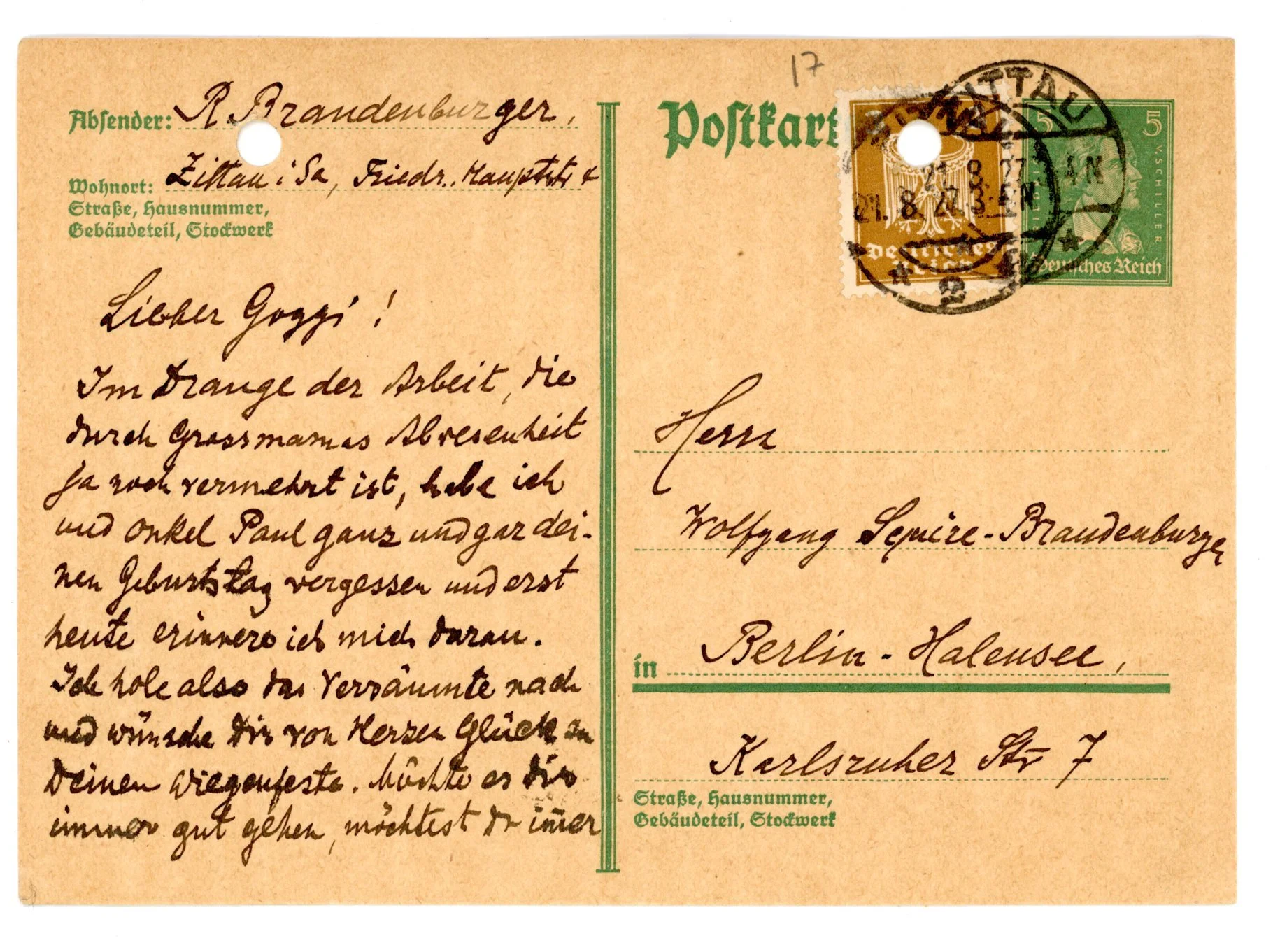
Richard was excited to report a visit of a Zeppelin when he wrote to Leo on 28 August 1929:
The day before yesterday we had the pleasure of seeing the Zeppelin over Zittau: it announced its arrival – as if someone had had a premonition of its coming – with the colossal roar of its propellers and engines, and had already vanished again before anyone really knew what was happening. It flew from here to Reichenberg and Proz, and then on home. The air force’s behaviour is somewhat peculiar: last year, a visit to Zetten was promised but cancelled at the last minute, so that all the welcoming preparations had gone to waste. Today it arrives unannounced and flies right over us, remains in sight for two minutes and disappears again, only to linger longer over the Mark when flying over Prague.
Example letters:
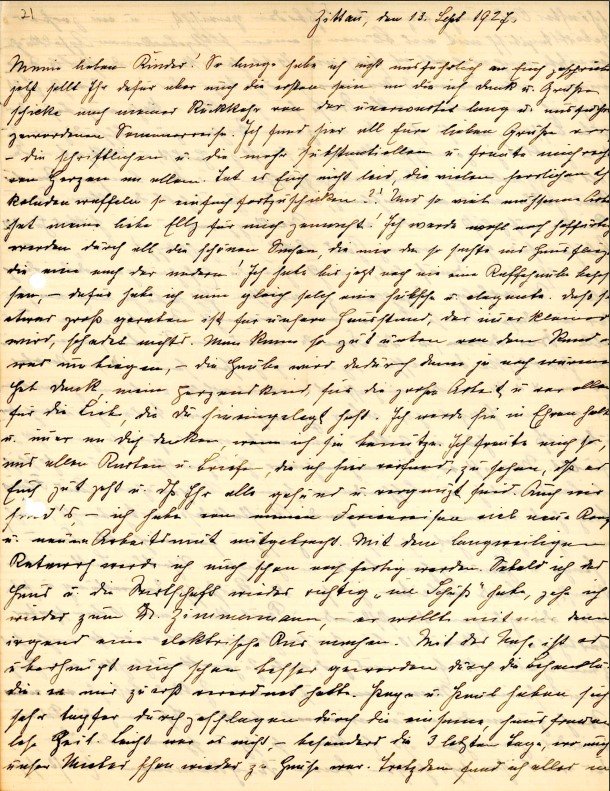
The women in the family were by far the most prolific letter writers This letter from Meta is a good example of her style:
Zittau – 7 November 1927
My dearest children! Since Paul’s departure, and since the autumn work has more or less come to an end, things have become quieter around me and I now find myself with the time and energy once more to give visible expression to my thoughts of you, my dears. For a long time now, the large pile of unanswered letters – some 15 in number! – has been staring at me reproachfully, so I shall now finally set about repaying my debt of gratitude. You have not seen or heard anything proper from me for so long, so I should be the first to break the ice.
As for our daily life, Paul, that scatterbrain, has probably already told you all about it – although, strictly speaking, he didn’t really know all that much about our lives! He was, after all, very busy and often out: on weekdays at work from early in the morning, in the evenings with friends, and on Sundays and public holidays playing tennis. So it was mostly an honour and a pleasure to keep his things in order and to fill his hungry stomach at the right time. Joy and youthful, fresh vigour his presence here did bring into the house, and his departure left a palpable void. Now he writes cheerfully and happily from Kiel; he has settled in nicely and comfortably with his new friend and is thus sailing into his second semester with a fair wind. Hopefully their friendship will deepen and grow stronger, for it could well turn out to be a very lovely thing.
We’ll also be attending the five most popular scientific or literary lectures organised by the ‘Association of Young Merchants’ at the town’s Bürgerhal once again – both season tickets are a birthday present from our little Eduse (Edit note: Edith’s nickname). Otherwise, we spend our evenings quietly at home – Papa reads to me a lot; he’s so relaxed. Our family social life is virtually non-existent. I do have a whole host of female friends with whom we exchange visits for coffee (alas, most of them are utterly uninteresting), but we no longer really socialise with Papa at all, since Trampedach and now also the dear old Prof. Lange have passed away. Professor Auerbach, whom we still see from time to time, is somehow not quite himself health-wise; he’s so eccentric and full of nonsense.
So Papa has absolutely no social life with men – I’m sorry about that, but how else is it to be. At our age, it’s no longer so easy to make new acquaintances, and even if his profession were to our liking, it wouldn’t fit in with any of our tastes and interests. The other day, Papa had to go to a colleagues’ gathering – he was utterly miserable beforehand, and was nearly at death’s door during the ‘entertainment’. So we remain in our loneliness at home – and, after all, we are quite content that way
My Mrs Pohl is still ill, though it now at least seems to be gradually improving. She spent four weeks in hospital, and the treatment she underwent there appears to have been successful. She had phlebitis, which had led to open sores on her left foot. She will probably not be able to come and work with me for quite some time yet. I have now resigned myself to my fate and am managing the task reasonably well. I shall not seek a new person. Given the practical circumstances that prevailed between me and my dear Pohl, I cannot find one, and otherwise the whole affair would be too costly for me.
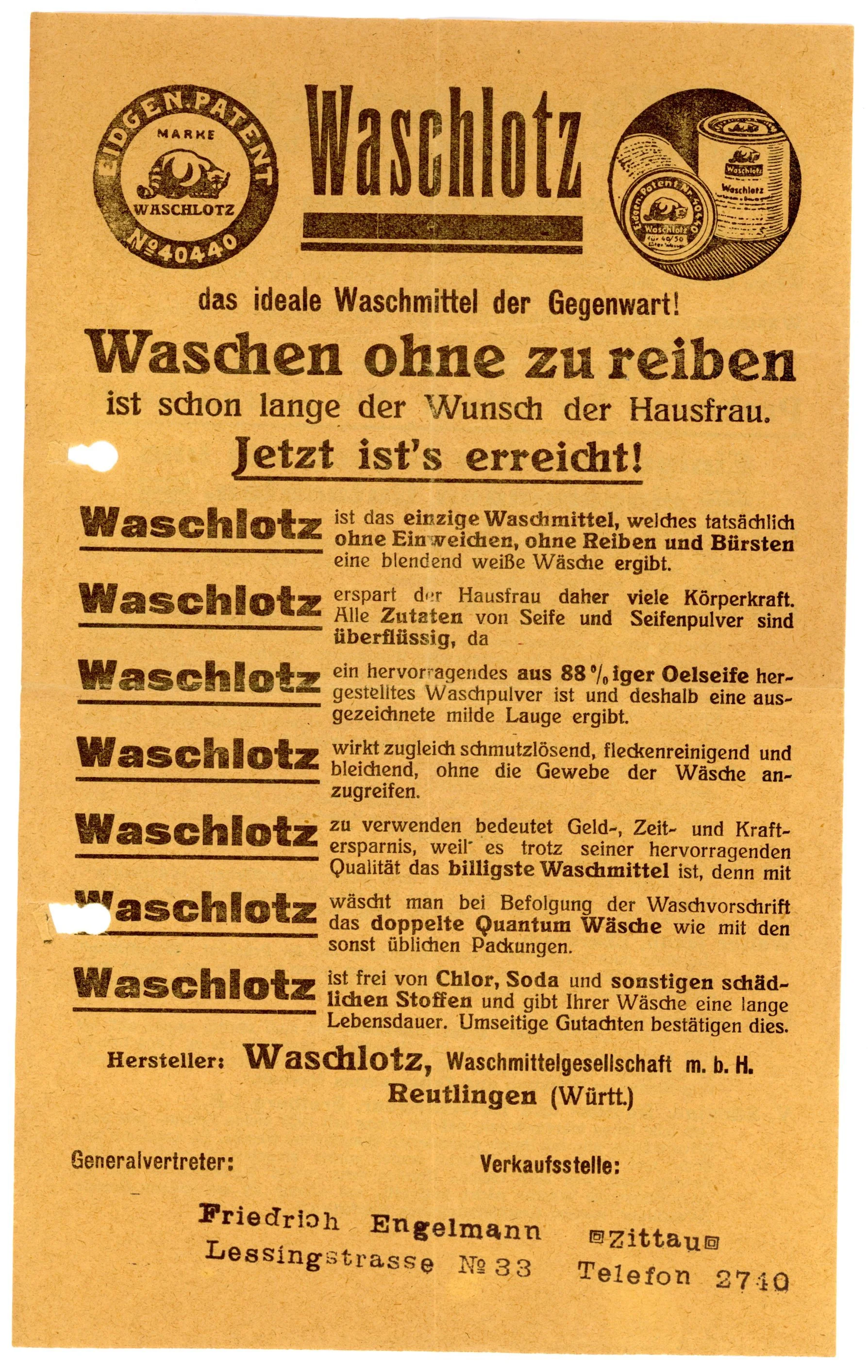
The task of scrubbing the stairs is taken care of by my upstairs neighbour, Mrs Kolbe. And the washing gets done quite easily with the help of ‘Lotz’ (EDIT: a detergent). – Once a week, in the afternoon, I visit poor old Mrs Lange, who – a heart-rending little bundle of misery – is now once again alone with a young in her deserted flat, and cannot in the slightest find her way back to life. She will certainly not have much longer to struggle – her frail body offers so little resistance in the face of such great suffering – nor does she possess any will to live or any vitality. One always makes such a great fuss when, in a young married couple, one partner is taken away prematurely. Ah, how much more shattering it is when, in the prime of life, one companion is left behind alone, helpless and in hopeless sorrow! In Mrs Lange’s case, there is the added difficulty that her eyesight is so very poor. She can hardly read or write, and cannot work at all. – At the Gärtners’, everything is carrying on as usual. Eva manages the whole bustling household with prudence and energy, and despite this still has the time and strength to think of her many friends and to act on their behalf in many ways. We do not see each other very often. They all have so much to do, and my life is also rather demanding, so that I do not get to visit them very often.
I would like to thank you most sincerely, my dear daughter-in-law, for your lovely letter, and also for letting me share so honestly in your worries and troubles. I can empathise with you so well; hearing of the children’s disappointing Michaelmas grades must have been disheartening and depressing for you— after all, I too was once young and expected wonders from my children.
Now, of course, I view all these matters much more calmly and objectively. There’s simply no point in forcing the issue – after all, patience is always the ultimate wisdom with which we can overcome such difficulties. By the way, is it not French, in particular, that both Wolfgang and Trude excel at? It seemed to me two years ago that it was precisely in this language that certain prerequisites for any progress with the others were laid down. As for Trude, you might now need to give serious consideration to whether she ought to be retrained, with a view to a possible future as a craftswoman. If she were to attend a school that affords her distinct talent more scope, perhaps her zeal and enthusiasm for work would gain greater momentum and thereby also influence her success. I did not speak to the trainee teacher because of her seemingly unfair attitude
It’s so easy to wish for that, so easy to let oneself be carried away by one’s professional circle and forget that this may well be quite different amongst one’s peers—less charming and praiseworthy than amongst adults. I am reminded of a personal experience I had with my son, who is now your authoritative guardian and father – he should tell you himself in detail: how he made me his form teacher, a man who was a dreadful scoundrel in his stories, and who had punished him unjustly. ‘Go on then, go on,’ he urged me, and his eyes were literally ablaze with schadenfreude at the teacher’s predicament. And in the end I was made to look a fool – the little rascal had been naughty after all, (dear Leo, wouldn’t you rather pin a string of report cards to the back of your coat to amuse your dear little remarks?), and that ‘hot-headed’ teacher turned out to be a very compassionate gentleman, who very tactfully eased my defeat and, as far as I know, didn’t hold the matter against the boy afterwards. Since then, I have never again resorted to such measures; children need not be liars and little devils – they are shaped by the eyes of others and influenced by the lively public spirit. Unless there are quite serious misdemeanours and injustices on the part of the teachers, one ought to refrain from any interference.
The situation is, of course, different for Wolfgang. In this case, I shall probably try to have a confidential discussion with the class teacher to help him understand the boy’s somewhat difficult character. He is, after all, a good lad, and also gifted, and has a great deal of positive knowledge. He simply lacks self-confidence, and a kind and understanding teacher could well nurture and strengthen this by opening his eyes to the child’s unique nature. By the way, my dear Elly, wasn’t Edith’s fresh and cheerful conclusion regarding your school worries with the children a heartening comfort to you? I still remember very well the scenes in which Papa took on the exact science with her, which always ended in disaster. ‘She’s so stupid you could run over your friends with her!’ says the desperate father. But the daughter wasn’t desperate at all, as she now naively believes – to make matters worse, despite all the scolding, she was simply: ‘Look at this, look at that – what a clever girl she’s become now.’ –– So don’t worry too much, my dear Elly, and above all: stop blaming yourself. Everything will sort itself out in the end. By the way, you haven’t mentioned a word about that little woman, Annemarie. Is she finishing at the municipal school at Easter too?
My ‘Wack’ project has now come to an end. In the pantry there’s a magnificent, impressive collection of over 50 jars! If Leo really does come after the holidays, he’ll be able to feast his eyes on my treasures too. I’m already very much looking forward to seeing my ‘big boy’ again. As for the radio that Edith is so anxious about, he really shouldn’t bother with it. I can only keep repeating: I have a great deal of patience and am very good at waiting. And after all, if the lad comes and then just settles in here again, he’ll get nothing out of the visit and we’ll get nothing out of him! So please, don’t bother – I’m longing for my son, not for the radio!
And now one more favour, my Elly: could you please make me a little pattern for your Annemarie, with proper sleeves and the exact length. Just in case, make one for Trude as well. Don’t forget to give me the exact measurements of the children’s hips, that is, how wide they are. It’s so cute when the clothes are a bit baggy, but they mustn’t be too tight either. By the way, how is Wolfgang’s windcheater holding up? I’d be interested to hear whether the fabric retains its colour. All of Paul’s windcheaters have worn out badly, even though the last one that Prinkes gave him – which was bought in a posh sports shop and cost a fortune – looked very good at first. Farewell for now, my dear ones. Give our love to the lovely foster parents from both of us. Papa has just come home; he sends his warmest regards.
With faithful love, your old Mama
Richard rarely wrote and was clearly satisfied that communication with the children was mainly a task for his wife. He did write an occasional letter, such as this one written to Leo on the occasion of his 30th birthday.
Zittau, 11-2-29
My dear boy.
On the occasion of your thirtieth birthday, I too would like to send you my warmest congratulations! Above all, may you be granted the chance to get your nose and ears through this Siberian cold unscathed (here, this morning, the temperature at the front window was 30° C below zero, and even now, at the warmest (!) time of the day, the thermometer has not risen above –18°). Thirty years! A short span of time, and yet it is enough to turn a young man into an old one. - In all seriousness, I wish you all the best, above all good health for you and your loved ones, then continued success in your career and lasting enjoyment of it.
Many thanks also for your lasting, yet somewhat fleeting Christmas present, the (presumably) final part of which I received a few days ago. We are already very much looking forward to Edith’s arrival, not least because her visit will give us the opportunity to have you over to our place again. As Mum is taking care of the current part of our report,
I can keep this brief, for I don’t have much time; I must get back to work straight away. Just this much: you mustn’t write any more secrets to me in English in future, because Mum has now (probably to thwart this) thrown herself wholeheartedly into learning this noble language and has made astonishing progress.
Admittedly, for the time being she is only learning with her eyes, but – l’appétit vient en mangeant – she will soon probably set about studying pronunciation as well, and so she’ll ask you to send her the Langenscheidt dictionary.
Well then, farewell to you all; a thousand greetings to each and every one of you, and please give my regards to the people of Neukölln from your
Father